Omofonie project: A story within a story
It was January 2006 when Progetto Omofonie went online for the first time, with no funds behind it but a lot of passion and determination. The idea of creating a digital archive of sources for the history of the homosexual movement and its thoughts was what moved the Omofonie founding group: a group of gay, lesbian, and feminist activists living in Livorno, Pisa, and Paris sharing a network of friendships, studies, and activism. Its members were Francesca Talozzi and Alessandro Corsi, the creators of the projects and its coordinators, Paolo Lambertini and Marianne Hitz, who took care of translations together with Alessandro Corsi, and Cristina Galasso and Sabrina Cicogna, who maintained the website.
A group heterogenous in education and skills, unified by a double and daring task: gathering and publishing online – for free and in a user-friendly manner – edited sources to reconstruct the history of the movement and homosexual thought, but most of all translate the foundational texts of LGBTQ history in Europe and North America between the XIX Century and XX Century from English, French, and German into Italian.
It was a large amount of publications printed by publishing houses and magazines from several European Countries: medical-scientific research, juridical research, historical essays, philosophy, anthropology, psychiatry and later manifestos, reports, novels, biographies, and memories that, starting from the 1800s, started shaping the concept of homosexuality, its perception, the history and culture of homosexual thought and what it became, in the 1900s, the Gay Right’s Movement and then the LGBTQAI+ Movement.
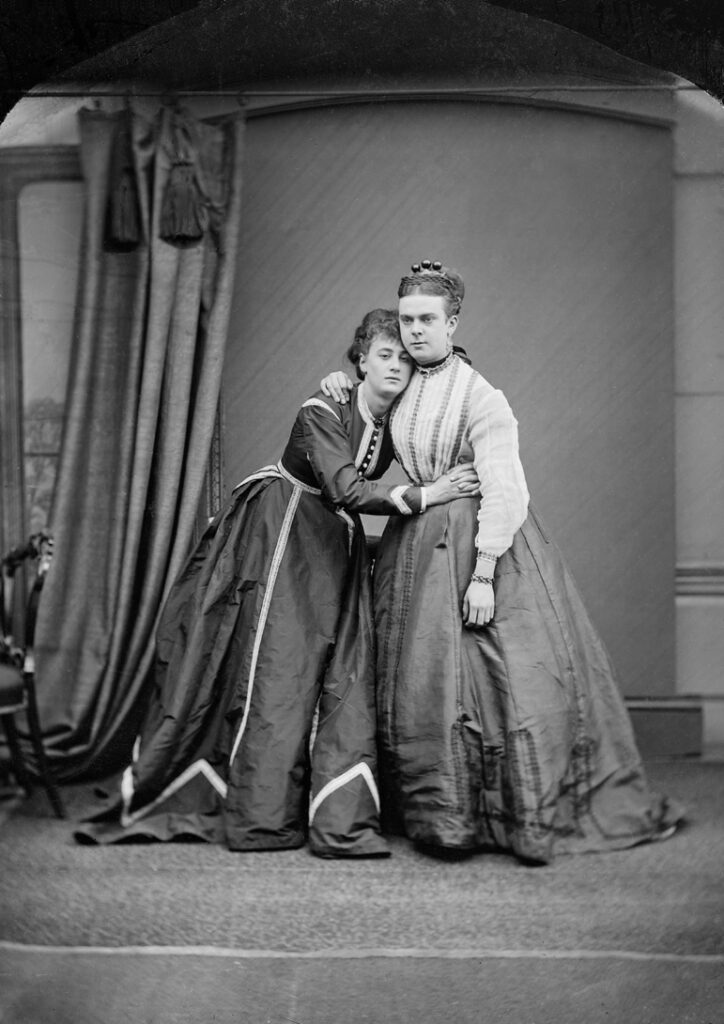
The founding group wrote what follows on Omofonie’s website:
While somewhat late compared to other western Countries – and mostly thanks to the arrival of the Internet, the wall of silence surrounding memory of homosexuality has started being broken in an increasingly systematic manner in Italy; in the latest years, accurate work from dedicated individuals has given life to exceptional research, and cultural websites dedicated to the theme. What we believe is still missing is an online way to access the sources needed to reconstruct the history of the movement and homosexual thought: Italian sources, of course, but also and most notably foreign ones. It’s through this perspective that Omofonie will try entering the already existing National landscape, mainly focusing on the period of time that, starting from the birth of late XIX Century movements, reaches up until the decade after Stonewall. In order to achieve this, we will exclusively use both documents and articles from magazines tied to different trends within the homosexual movement, and writings from individuals whom, despite not being openly part of the movement itself for ideological or other reasons, fought for the achievement of the most basic gay and lesbian rights. Project Omofonie’s target audience is for anyone that may want to discuss the topic of homosexuality and its history, beyond any political and ideological barriers. Therefore, the only selection criterion for the texts is the importance we will attribute to them, in order to display the diversity within the homosexual movement throughout its history. Another point of the project we consider as necessary is an equal division between the space dedicated to gay themes and lesbian themes, because we are committed to reviving the contact between the two communities – which we believe have increasingly strayed away from the idea of a communal commitment.
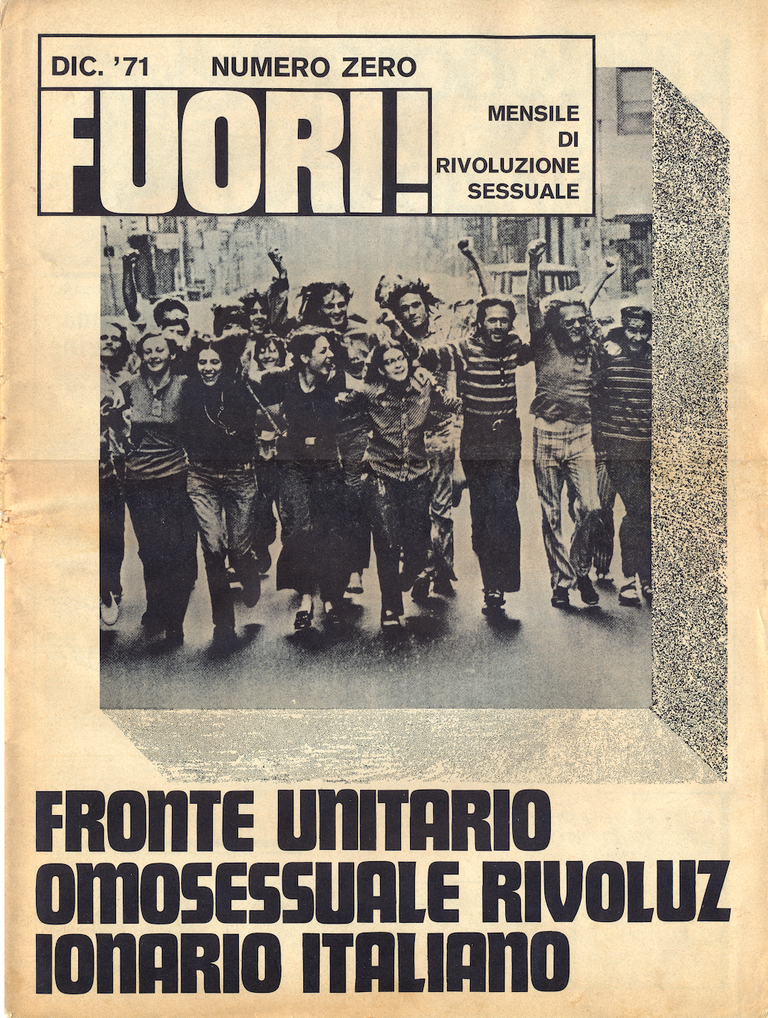
From two to four gay and lesbian themed texts were published online every month and, thanks to the partnership with Fondazione Sandro Penna, a digital scan of historical
magazine “Fuori!” was made available as well; later on, numbers from the magazines “Lambda” and “Bollettino del Coordinamento Lesbiche Italiane” were added too.
For what concerned all foreign texts, the Italian translation was always published with either a digital copy of its original source, or, if the document was already available online, a link to the site was provided instead.
Other than Fondazione Sandro Penna, many translated and published texts were found thanks to precious collaborations, such as that with the Library of Casa della donna (Women’s house) in Pisa, Biblioteca delle donne (Women’s library) in Bologna, and then Schwules Museum in Berlin, Homosexuelle Arbeitsgruppen in Zurich, and Centre International de Recherches sur l’Anarchisme in Geneva.
From 2006 to 2011, project Omofonie published a total of 100 Italian and foreign texts from 62 authors.
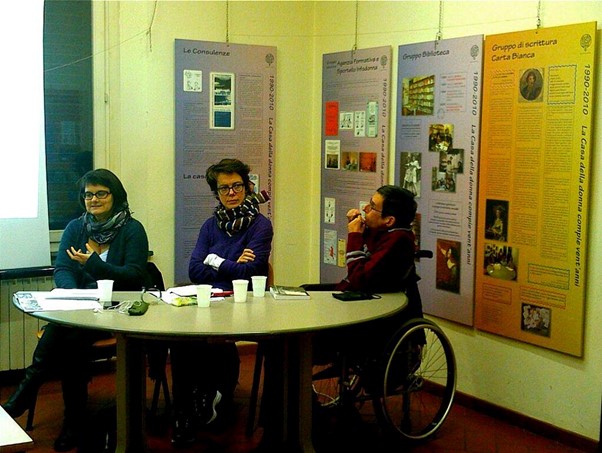
Omofonie launched Archivi della Storia e della Memoria Lgbtq (Archives of LGBTQ History and Memory) in 2013-2014, thanks to an investment from Cesvot – Centro Servizi Volontariato Toscana (Toscana’s Service Center for Volounteering) and collaboration with Arcilesbica Pisa and the association Casa della donna: a new project that, other than giving a follow-up to the work of Omofonie, promoted a series of encounters and seminars dedicated to LGBTQ history and memory in Pisa, and was attended by scholars and activists from all over Italy.
A great part of that project, as well as Omofonie itself, was the result of the passion and dedication of Francesca Talozzi, who left us on May 6 th 2022 after a long battle against illness. In 2019, after her participation to 3-day event Lesbix in Bologna with an intervention on lesbianism and disability, Francesca decided to donate Omofonie’s entire documentation to Cassero’s Documentation Center. Then the pandemic struck, her illness worsened and everything came to a halt.
Now, Francesca’s wish for the monumental work not to become lost and inaccessible again has finally become a reality. We dedicate the new life of project Omofonie to her, whom always reminded us how wonderful and fallacious memory can be through the words of Primo Levi.
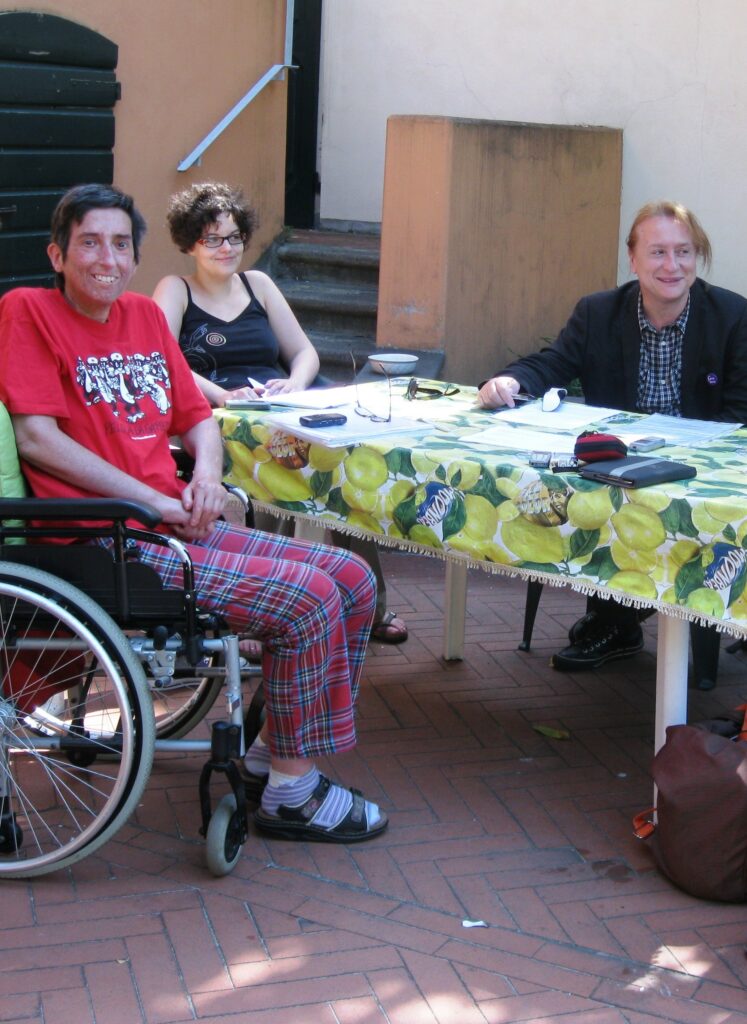
Francesca Talozzi (Livorno, January 7 th 1963 – May 6 th 2022) was an archeologist and then a playwriter, a tireless feminist and activist for Women’s rights, LGBTQ people’s rights, and an advocate for people with disabilities. She was active in the association Casa della donna di Pisa since 1995, and in 1997, after she became ill with a rare rheumatic condition, she left archeology to dedicate herself to her passions: writing and theatre. She founded the Effetto Collaterale (Side Effect) company in Livorno, 2009 with Alessia Cespuglio, and staged plays on the Moby Prince ferry carnage, Sylvia Plath, the Mirabal sisters, Artemisia Gentileschi, Giorgio Caproni, Walter/Wendy Carlos, Charlotte Delbo. Her posthumous collection of poems called Il corpo e la radice (The body and the root) was published in December 2022 with Ets publisher.
Index of the texts published on Omofonie
Omofonie was not an editorial and commercial venture: the texts, with their precise bibliographical information, have been translated in Italian and redistributed in accordance with current law. Italian translation of foreign texts are “copy left”, with mention of the translator’s name, of project Omofonie and a link to the page centrodocumentazionecassero.it/progetti/omofonie. If any individual were to have legitimate reasons to consider the online distribution one of the texts as an infringement, we’d be willing to either retract it from the site or pay for necessary licensing fees.
Atti del convegno di donne lesbiche, Roma 26-28 dicembre 1981, in “Differenze”, n. 12, 1982
R. von Braunschweig, Felicita von Vestvali, in “Jahrbuch für sexuelle Zwischenstufen”, 1903
M.F., Come la vedo io [Wie ich es sehe], in “Jahrbuch für sexuelle Zwischenstufen”, 1901
Una Tribade, Tribadismo. Saffismo – Clitorismo, Il Pensiero, Firenze 1914
Sentenza del Tribunale della Città contro gli autori di “Inversions”, Parigi, 20 marzo 1926
Sur le Seuil, editoriale della rivista “Inversions”, n.1, 15 novembre 1924
R. Macrelli, G. Pala, Lesbismo – Femminismo. Contributo di donne lesbiche di Pompeo Magno, Roma 1983
Guglielmo Bilancioni, Una viragine regina: il virilismo di Cristina di Svezia, in “Rassegna di studi sessuali”, anno IV, n. 5, settembre-ottobre 1924, pp. 312-327
Bollettino del CLI, anno II, n. 6, giugno 1983
Bollettino del CLI, anno II, n. 7, settembre 1983
Bollettino del CLI, anno II, n. 10, dicembre 1983
Bollettino del CLI, anno IV, gennaio-febbraio 1985
Bollettino del CLI, anno IV, maggio-giugno 1985
Bollettino del CLI, anno IV, luglio-agosto 1985
Bollettino del CLI, anno IV, settembre 1985
Bollettino del CLI, anno IV, ottobre 1985
Bollettino del CLI, anno IV, novembre-dicembre 1985
Bollettino del CLI, anno IV, gennaio-febbraio 1986
Bollettino del CLI, anno V, marzo 1986
Bollettino del CLI, anno V, aprile 1986
N. Praetorius, La Questione dell’omosessualità in Germania, in “Rassegna di studi sessuali”, 1922, anno II, maggio/giugno, pp. 148-157
Anonima, Commissione omosessualità, in “Effe”, anno V, n. 7/8, luglio-agosto 1977, p. 30
Anonima, Dialogo di una omosessuale, in EFFE, anno IV, novembre 1976 – n.11, pp. 12-14
Anonima, Donna più donna ovvero l’esclusione, in EFFE, anno IV, dicembre 1976 – n.12, pp.15-17
Bollettino del CLI, anno V, maggio-giugno 1986
Bollettino del CLI, anno V, luglio-agosto 1986
Bollettino del CLI, anno V, settembre 1986
Bollettino del CLI, anno V, ottobre-novembre 1986
Bollettino del CLI, anno V, dicembre 1986
Bollettino del CLI, anno VI, gennaio-febbraio 1987
Bollettino del CLI, anno VI, luglio-agosto 1987
Bollettino del CLI, anno VI, settembre 1987
Bollettino del CLI, anno VII, gennaio 1988
Filippo Pacini, Di alcuni pregiudizi in medicina legale, Firenze, Tipografia Cooperativa, 1876
Homosexuelle Straffreiheit in Polen. Freundschafts-Banner, n°19, 1932
Johanna Elberskirchen, Was ist Homosexualität?. Die Freundin, 1929
Ernest Raynaud, La mort de J.B. Nattier. Mercure de France 15-VII-1928, pp. 324-340
Ernest Raynaud, Voltaire et les fiches de police. Mercure de France, vol. XI, 1927, pp. 536-557
Bollettino del CLI, anno VI, marzo 1987
Bollettino del CLI, anno VII, febbraio 1988
Bollettino del CLI, anno VII, marzo 1988
Bollettino del CLI, anno VII, aprile 1988
Bollettino del CLI, anno VII, maggio-giugno 1988
Bollettino del CLI, anno VII, luglio-agosto 1988
Bollettino del CLI, anno VII, settembre 1988
Bollettino del CLI, anno VII, ottobre 1988
Gaston Dubois-Desaulle, Les Mignons du Marquis de Liembrune. Mercure de France, 1902, pp. 382-412
Charles Féré, Contribution à l’étude de la descendance des invertis [Contributo allo studio della discendenza degli invertiti] Archives de Neurologie, n°28, 1898, pp. 1-16
L’Amore Omosessuale / a cura di Aldo Mieli Roma, Edoardo Tinto Editore, 1926
Il lesbismo tra desiderio e paura / Liana Borghi Roma : CLI, 1988, pp. 15
Bollettino del CLI, anno VIII, gennaio 1989
Bollettino del CLI, anno VIII, febbraio 1989
Bollettino del CLI, anno VIII, marzo 1989
Bollettino del CLI, anno VIII, giugno 1989
Anno 2011
AA.VV, La soggettività lesbica, parte seconda, pp. 61-105, Milano 1998